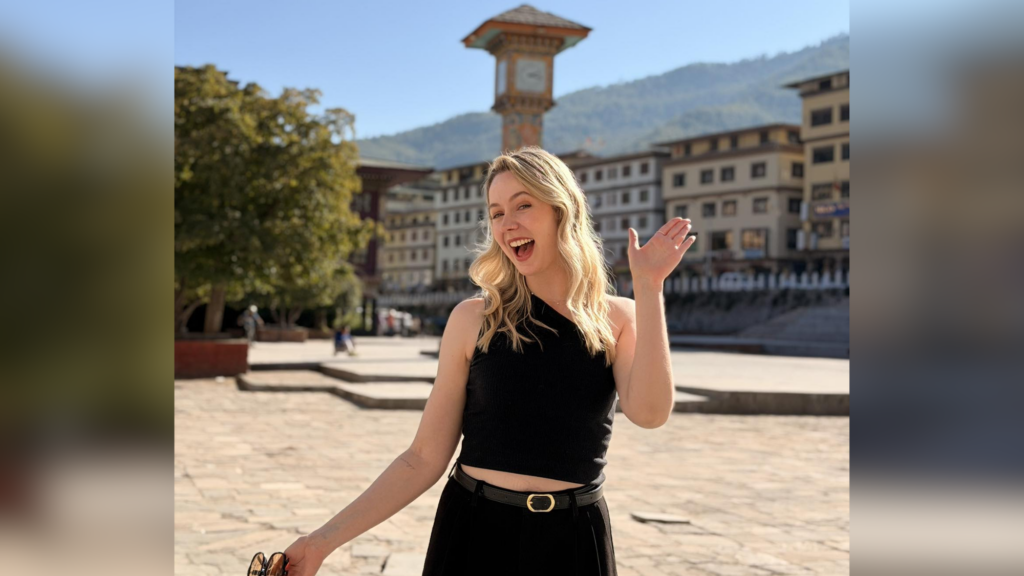
“Ngi gi ming Samantha En. Nga lo sum chu so chi en (I’m Samantha and I’m 31).
Growing up in Australia, I never quite fit in at school. Raised by a single mother and being the chubbiest kid in class, I often found myself the target of bullying. When I became an adult, I traveled the world before deciding to become a primary school teacher. My own childhood taught me what a classroom should feel like. I wanted mine to be a place of compassion and kindness, a space where no child felt small or unwanted. I wanted to be the teacher who showed her students that no one has the right to bring them down.
Through the New Colombo Plan scholarship, I came to Bhutan. From the moment I arrived, I felt a warmth that was new to me. Paro College of Education felt like home. Once, I was asked to judge a fashion show. I had no experience teaching anyone how to walk a runway, but I could cheer them on with all my heart. One student shocked me with an incredible walk and later asked me to be in a TikTok video with him. Until then, I had never even used TikTok. The video went viral. I had loved dancing as a child but never thought I was good enough. On TikTok, I found myself reliving that childhood dream, dancing freely again. Even my Teacher’s Day dance went viral. Soon I was making more videos than I could keep track of, capturing my days in Bhutan and sharing them.
As part of the scholarship, I met His Majesty the King. I stood right in the front, nervous and excited. His Majesty recognized me from TikTok and told me my videos were sweet. In that moment, every bit of Dzongkha I had practiced for weeks disappeared from my mind. I realised then that representing a culture that is not my own is a responsibility that requires care, sensitivity, respect and guidance from the people of that culture.
I returned to Bhutan a second time as a teacher. I wanted to go to Lunana, but the Ministry of Education did not want to send me on such a difficult journey, so they posted me to Buli instead. The first days were challenging. To shower, I had to boil kettles again and again to collect enough hot water. I survived on Koka noodles. The teachers took turns inviting me for dinner. My students were extraordinary. They woke at four in the morning to study, attended classes all day and even cleaned my surroundings as a gesture of kindness.
Back in Australia, I thought deeply about making videos about Bhutan. I knew that if I stopped sharing my experience, stopped wearing my kira or practicing Dzongkha, then I would be nothing more than a foreigner who had borrowed a culture only when it suited her. So I continued to make videos, to remember Bhutan, to stay connected with the Bhutanese community in Australia and even drove to Canberra for His Majesty’s birthday celebration.
In the following months, I worked hard on my thesis. I wrote about what I learned as a teacher immersed in Bhutanese culture and why we must celebrate culture without appropriating it. I wear my kira wherever I go and keep practicing my dzongkha. I hope that somewhere, a Bhutanese child growing up in Australia and facing racism might see me and feel encouraged to take pride in their culture.”
Story by Dechen Wangdi